A Practical Digital Transformation Roadmap for SMEs in India and Southeast Asia
How growing businesses can modernise operations in controlled stages without turning transformation into a collection of disconnected technology purchases.
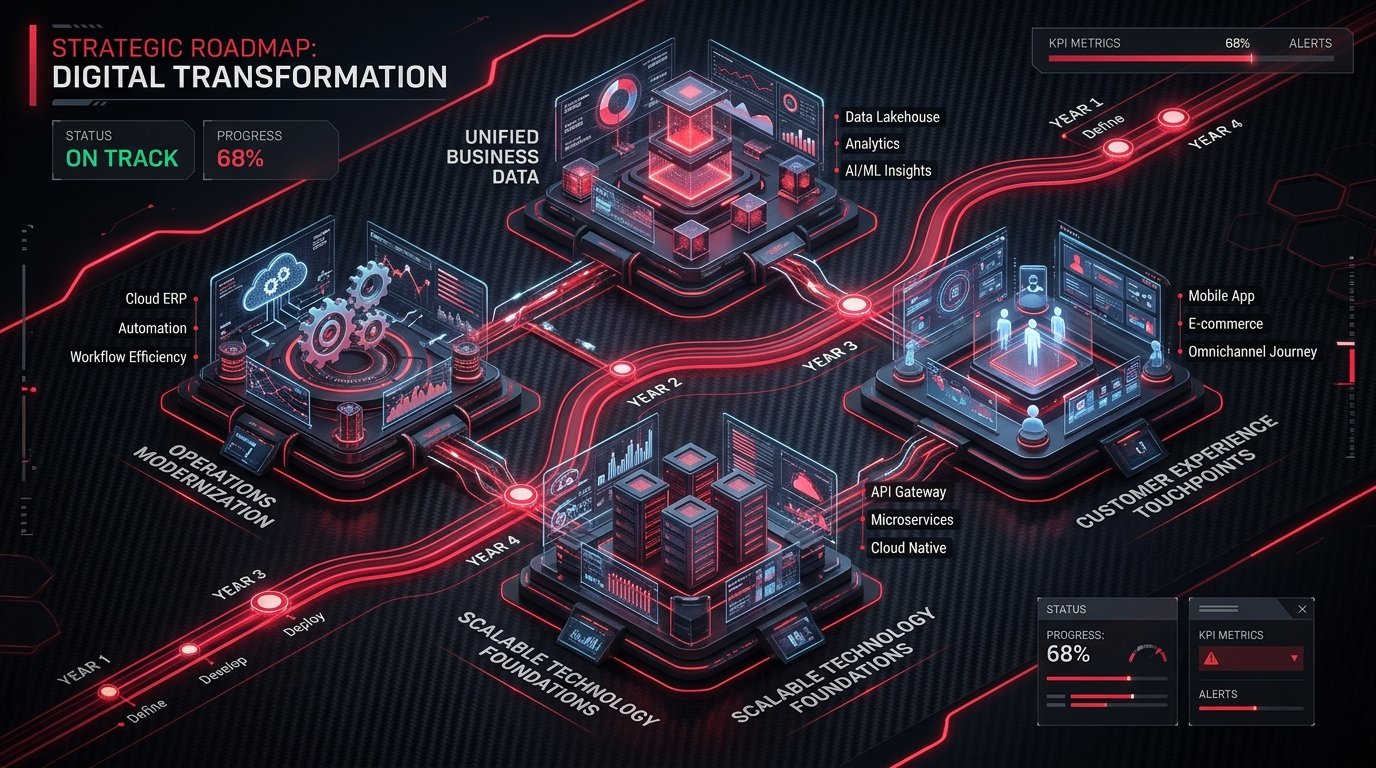
Digital transformation is often presented as a destination: move to the cloud, automate with AI, launch an app or replace an older system. For a growing business, transformation is better understood as a sequence of operating improvements supported by technology.
The organisation does not become transformed because it owns more software. It becomes more capable when information moves clearly, employees can act with less friction, customers receive a more reliable experience and leaders can make decisions from trustworthy data.
A practical approach to digital transformation for SMEs begins with one business constraint and grows through evidence.
Why transformation programmes become fragmented
SMEs often purchase tools in response to immediate pain. Sales adopts a CRM, finance retains accounting software, operations builds spreadsheets, marketing adds automation and management requests a dashboard. Each decision may be sensible, but no one owns the flow between them.
Common consequences include:
Transformation needs an operating view before a technology catalogue.
Step 1: Define the business outcome
Choose a problem visible to customers, employees or financial performance. Examples include slow quotation turnaround, poor service visibility, repeated document entry, inconsistent branch reporting or limited customer self-service.
Write the desired change in operational language. “Implement a CRM” is a solution. “Give sales and service teams one reliable view of every customer interaction” is an outcome.
Step 2: Map the current workflow and data
Follow a real transaction from beginning to end. Record systems, people, decisions, documents, delays and exceptions. Identify where data is created, copied, corrected and reported.
This map reveals whether the priority is process simplification, integration, better software or clearer responsibility.
Step 3: Establish a digital foundation
Before advanced automation, strengthen the basics:
AI and analytics cannot compensate for fragmented or untrusted foundations.
Step 4: Prioritise one connected journey
Select a workflow that crosses an important boundary—for example, enquiry to quotation, appointment to payment, or document intake to approval.
Deliver the journey end to end. Avoid implementing several tools that each digitise one isolated step. The result should reduce hand-offs and create a measurable improvement for a defined user.
Step 5: Choose the right solution model
Evaluate configuration, integration and custom development.
Use standard software for common capabilities. Integrate strong systems when data flow is the main problem. Build custom software when the workflow is central to differentiation or cannot be supported coherently by available products.
The architecture should be proportionate to the current stage while preserving data access and future options.
Step 6: Design adoption with employees
Transformation changes responsibilities and habits. Employees should participate in workflow design, pilot testing and improvement.
Explain:
Running old and new processes indefinitely creates double work and prevents reliable data.
Step 7: Measure the operating result
Choose measures connected to the original problem. Examples include turnaround time, incomplete records, repeated entry, customer update frequency, queue age, adoption or the time required to prepare a management report.
Technical measures—availability, response time and errors—are also important, but they should be linked to the business journey.
Step 8: Expand through reusable capabilities
After one workflow is stable, reuse its foundations. Identity, role management, audit trails, customer data, notifications and reporting may support the next journey.
This creates a platform approach without requiring a large platform programme from the beginning.
Regional considerations
Businesses operating across India, Malaysia, Singapore, Sri Lanka and Australia may need to account for different currencies, taxes, payment methods, languages, data expectations and customer communication habits.
Do not assume that localisation means copying one interface and changing the currency symbol. Map the operational and regulatory differences that affect the workflow. Maintain one coherent product where possible, using configuration rather than separate country-specific codebases.
Where AI belongs in the roadmap
AI should follow a clear information flow. Once the organisation has structured data, defined decisions and observable workflows, AI may help classify, extract, recommend or detect exceptions.
Beginning with AI before the foundation is stable can create fast output with weak accountability. Begin with bounded, measurable tasks and retain human oversight where errors have meaningful consequences.
A 12-month transformation pattern
Quarter 1: clarity and foundation
Map priority workflows, establish ownership, clean essential data and fix security or access gaps.
Quarter 2: first connected journey
Configure, integrate or build the first end-to-end workflow. Pilot with a defined group.
Quarter 3: adoption and visibility
Improve the workflow, retire duplicate steps and establish operational dashboards based on reliable data.
Quarter 4: expansion and intelligent automation
Extend reusable capabilities to the next workflow and introduce targeted automation where evidence supports it.
The timeline should adjust to the organisation’s capacity and risk. The sequence matters more than the calendar.
The bottom line
Digital transformation is not a technology shopping list. It is the disciplined redesign of how information, decisions and customer value move through the business.
Start with one constraint, build a reliable foundation, deliver a complete journey and expand through evidence. This gives SMEs a transformation programme they can operate—not only a presentation they can approve.
RECOMMENDED NEXT STEP
Plan Your Transformation Roadmap
Plan Your Transformation Roadmap — link to /contact or the relevant product enquiry form.
QUESTIONS & ANSWERS
Frequently Asked Questions
Where should an SME begin digital transformation?
Begin with a high-friction business workflow that affects customers, employees or decision-making and can be measured before and after improvement.
Does digital transformation require replacing every system?
No. Many organisations should retain strong systems of record and improve the workflow through configuration, integration or focused custom applications.
When should AI be added?
After the workflow, data, ownership and risk controls are clear. Start with a bounded task whose output can be evaluated and corrected.
SOURCES & BACKGROUND
Authoritative References
These references support the technical concepts. The article should retain original Aurae analysis rather than reproduce source wording.
- ▪Aurae Software Solutions — About
- ▪Aurae Software Solutions — Expertise
- ▪NIST — AI Risk Management Framework