Scalable Software Architecture: Building Event-Driven Systems for Global Growth
How event-driven architecture, resilient services and observable delivery pipelines can support scale—without turning every application into a distributed-systems experiment.
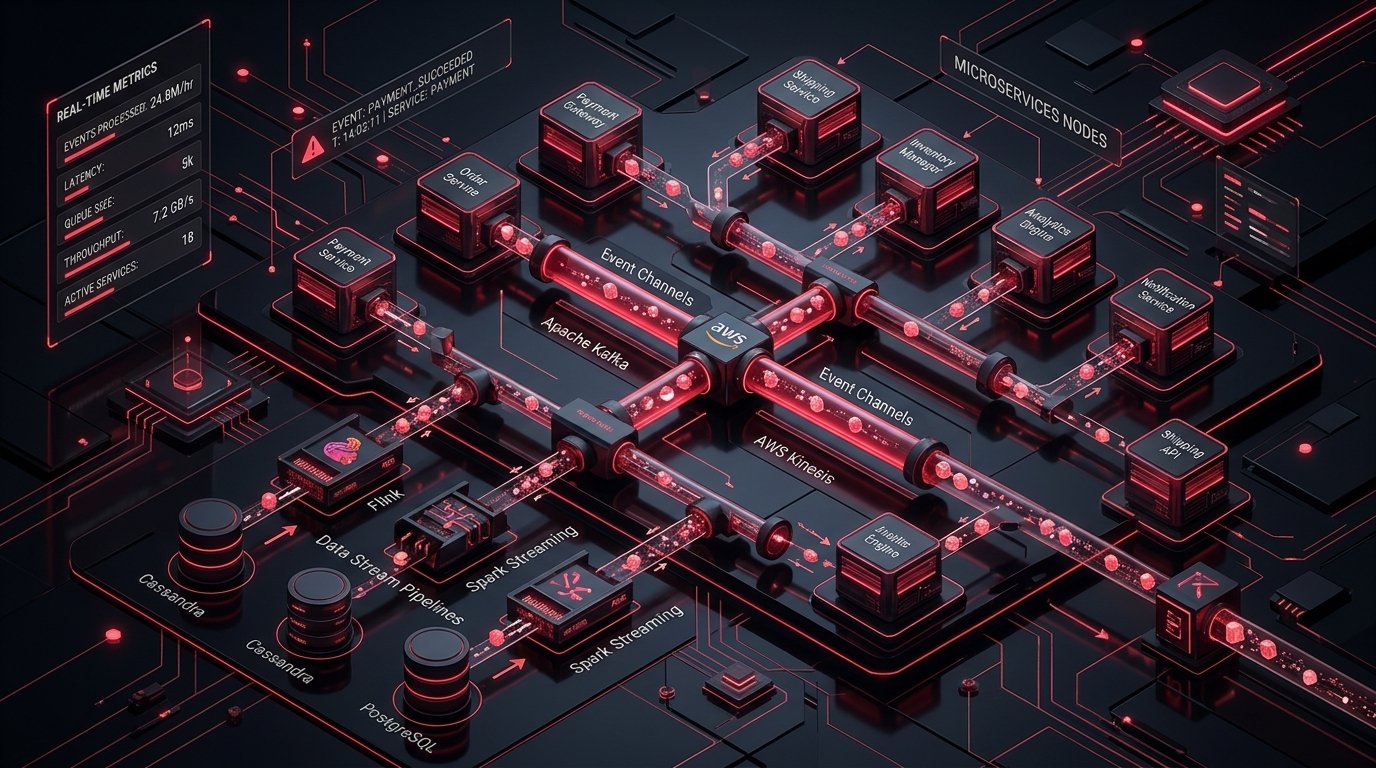
Scalability is often described as the ability to handle more users. In practice, a scalable software architecture must handle several forms of growth at once: more transactions, more data, more integrations, more teams, more regions and a faster pace of change.
An application can survive a traffic spike and still be difficult to scale as a business. If every new integration requires changes across the entire codebase, or every release risks interrupting unrelated features, infrastructure capacity is only part of the problem.
Event-driven architecture is one way to reduce this coupling. It allows parts of a system to communicate through business events—such as “appointment created”, “payment completed” or “inventory threshold reached”—instead of requiring every component to call every other component directly.
The result can be a more responsive and extensible platform. It can also introduce difficult operational problems. The architecture is valuable when its trade-offs match the business domain, not because event streaming or microservices sound modern.
What event-driven architecture actually means
An event represents something that has already happened and may matter to other parts of the system. An event-driven system normally contains three roles:
Consider an automotive workshop platform. When a digital job card is approved, several activities may follow: the workshop schedules work, inventory reserves required parts, the customer receives confirmation and reporting updates expected revenue. A tightly coupled application might execute these activities through one long request. An event-driven approach can publish a `JobCardApproved` event and allow each interested component to respond independently.
This separation means a new consumer—perhaps a loyalty service—can be added without changing the job-card producer. It also means consumers can scale according to their own workload.
When the pattern is useful
Event-driven architecture is strongest when multiple subsystems need to respond to the same business event, when workloads arrive unevenly, or when near-real-time processing creates meaningful value.
Typical cases include:
It may be unnecessary when the application is small, the workflow is a straightforward request and response, and strong consistency is required immediately. Adding a broker, retry policies, distributed tracing and schema governance to a simple workflow can increase cost and reduce clarity.
The engineering decisions that determine reliability
Publishing an event is easy. Operating an event-driven system responsibly requires deliberate choices.
Delivery guarantees and idempotency
Networks and consumers fail. An event may be delivered more than once, arrive later than expected or be processed after another related event. Consumers should be designed so repeating the same event does not create duplicate charges, duplicate messages or corrupted state. This property is known as idempotency.
Eventual consistency
When independent consumers update at different times, different parts of the system may briefly show different states. This is an expected trade-off in many asynchronous designs. Teams must decide where that delay is acceptable and where a synchronous or transactional boundary is required.
Schema evolution
Producers and consumers rarely change at the same moment. Events need clear contracts and a versioning strategy so a new field or structure does not break older consumers. A durable event should describe a stable business fact rather than expose an internal database record.
Observability
A single customer journey can cross several producers, channels and consumers. Correlation identifiers, structured logs, traces and business-level metrics must be designed from the beginning. Without them, the system can be technically distributed and operationally invisible.
Failure recovery
Retries require limits, backoff and a destination for events that cannot be processed. Dead-letter queues are useful only when someone owns the process for investigating and replaying them. Recovery is an operating capability, not a queue configuration.
Security and data minimisation
Events can be visible to several consumers. Sensitive information should not be included simply because it is available. Access policies, encryption and retention must reflect the data carried by each channel.
Microservices are not a prerequisite
Event-driven architecture and microservices are often discussed together, but they are not the same decision. A modular application can publish internal events while remaining one deployable unit. This may provide useful separation without the operational burden of many distributed services.
Microservices become more compelling when business capabilities have clearly different scaling, release, ownership or isolation needs. They become dangerous when a team divides the system before it understands those boundaries. Network latency, distributed failure and cross-service data consistency can turn a simple domain into a complex operating environment.
A practical adoption path
Organisations do not need to redesign every system at once. A safer path is incremental.
Designing for global growth
Global scale introduces data residency, network distance, regional failure and local integration requirements. Event-driven patterns can help isolate regional workloads and prevent slow downstream processes from blocking the customer interaction. They do not remove the need for careful data ownership and consistency design.
The architecture should be evaluated through business questions: Which journeys must remain available during a regional failure? Which data must stay within a location? Which events can be processed later? Which partners need reliable integration contracts? These answers shape the platform more effectively than a generic “global architecture” diagram.
The bottom line
Event-driven architecture can create a responsive, extensible foundation for complex products. Its value comes from decoupling business capabilities and allowing them to evolve independently. Its risk comes from treating asynchronous distribution as invisible complexity.
Use the pattern where business events, independent scaling and real-time reactions matter. Keep simpler interactions simple. Above all, design observability, recovery and ownership as part of the architecture—not as work to be added after scale arrives.
RECOMMENDED NEXT STEP
Discuss Your Architecture
Discuss Your Architecture — link to /contact or the relevant product enquiry form.
QUESTIONS & ANSWERS
Frequently Asked Questions
Is event-driven architecture always faster?
No. It can improve responsiveness by moving non-critical work outside the user request, but brokers, serialisation and consumer processing introduce their own latency. The relevant measure is the performance of the complete business journey.
Do event-driven systems require microservices?
No. A modular monolith can use events internally. Microservices should be introduced only when independent deployment, ownership, scaling or isolation creates enough value to justify distributed-system complexity.
What should teams monitor?
Monitor event publication and consumption rates, processing latency, failures, retries, dead-letter queues and end-to-end business outcomes. Technical health should be connected to journeys users and operators recognise.
SOURCES & BACKGROUND
Authoritative References
These references support the technical concepts. The article should retain original Aurae analysis rather than reproduce source wording.
- ▪Microsoft Azure Architecture Center — Event-driven architecture style
- ▪AWS Well-Architected Framework