SaaS Architecture: Balancing Performance, Scale and Maintainability
The architecture decisions that help a multi-tenant SaaS product grow without creating avoidable operational or security risk.
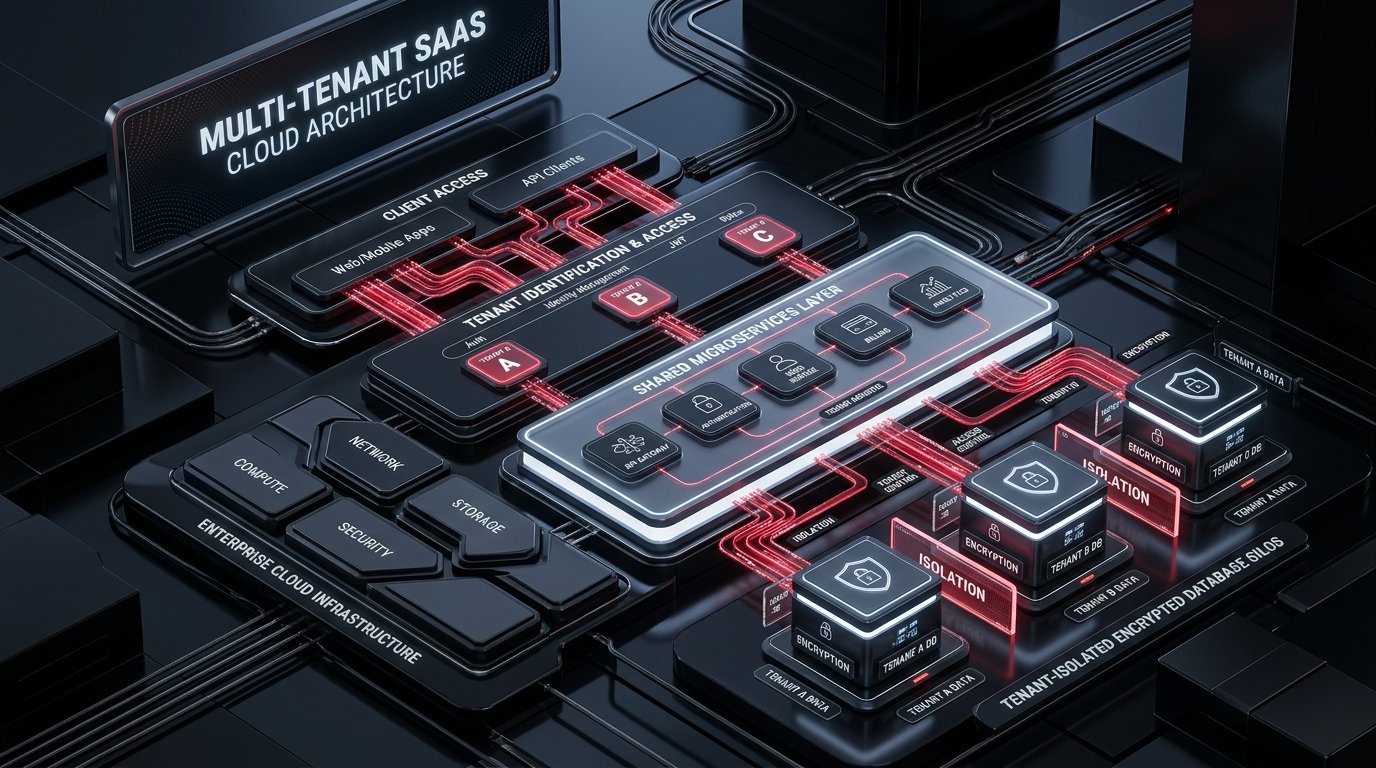
A successful software-as-a-service product must do two things at the same time. It must feel specific enough to solve each customer's problem, while operating as one coherent product that can be improved, secured and supported at scale.
That tension is the heart of SaaS architecture. Multi-tenancy is not simply a database technique. It affects identity, data isolation, onboarding, configuration, billing, observability, support and the economics of operating the platform.
The right architecture depends on the product, customer profile, compliance needs and stage of growth. There is no universal diagram that makes a SaaS business scalable.
Begin with the tenant model
A tenant is the customer organisation or account consuming the service. Each user must be associated with the correct tenant, and every operation must apply that context consistently.
Before choosing infrastructure, define:
Unclear tenancy rules spread across the codebase and become difficult to correct later. Tenant context should be a first-class part of identity, authorisation, data access, logging and metrics.
Pool, silo and bridge models
SaaS systems commonly use variations of three isolation models.
Pool
Tenants share infrastructure and often share data stores, with logical controls separating their information. Pooling can improve resource efficiency and simplify unified operations. It demands consistent tenant-aware access controls and strong testing against cross-tenant exposure.
Silo
Each tenant receives dedicated infrastructure or data stores. This can support specific compliance, performance or contractual requirements, but it increases provisioning and operational cost. A silo model should still be automated and managed as one product—not maintained as unrelated customer installations.
Bridge
The platform combines shared and isolated components. For example, application services may be shared while sensitive data is stored separately for selected tenant tiers. This provides flexibility but requires clear operational visibility across both models.
The correct choice may differ by service. Isolation is a risk and business decision, not a badge of architectural sophistication.
Identity and tenant isolation
Authentication answers who the user is. Authorisation answers what the user may do. SaaS adds another essential question: within which tenant context is the action being performed?
Tenant context should flow through each service and data operation without relying on client-supplied identifiers that can be changed freely. Shared libraries, policies and automated tests can make tenant enforcement consistent while reducing the burden on individual developers.
Isolation must also cover caches, files, search indexes, analytics, background jobs, logs and support tools. A database query filter is not a complete isolation strategy.
Onboarding is part of the product architecture
Manual onboarding limits growth and introduces configuration differences. A scalable SaaS platform should create tenants through one repeatable process that provisions identity, configuration, entitlements, data boundaries and initial administration.
The customer experience matters as much as infrastructure. New tenants need a clear path to first value: importing essential data, inviting users, configuring workflows and completing the first meaningful task.
Performance should be measured per tenant
A global average can hide a poor experience for an individual tenant or plan. SaaS observability should make it possible to understand consumption, latency, errors and cost by tenant or tenant tier while respecting privacy.
This helps teams identify noisy-neighbour effects, unexpected consumption and features that create disproportionate infrastructure cost. It also makes support more precise: the team can investigate the affected tenant's journey instead of searching only through system-wide metrics.
Design for change, not hypothetical perfection
Products need the ability to evolve. This does not require every product to begin with microservices, event streaming and global active-active infrastructure.
A modular architecture with clear domain boundaries can support considerable growth while remaining simpler to test and operate. Services should be separated when there is evidence that independent scaling, deployment, ownership or isolation will create meaningful value.
Technical debt cannot be reduced to zero. Some debt is a deliberate trade-off made to learn quickly. The important discipline is to make the trade-off visible, understand its consequences and allocate time to repay debt that is slowing the product or increasing risk.
Capabilities that deserve early attention
Entitlements and configuration
Plans, features and tenant-specific settings should be represented explicitly. Scattered conditional logic makes pricing and product evolution difficult.
Auditability
Important changes should record who acted, within which tenant, what changed and when. Audit records support troubleshooting, security and customer trust.
Deployment and rollback
A SaaS provider normally operates one evolving product. Automated testing, controlled releases, database migration discipline and rollback options protect every tenant during change.
Data lifecycle
Define retention, export, backup, recovery and deletion. These capabilities become difficult if data ownership is unclear.
Cost visibility
Infrastructure cost should be connected to tenant activity and product capabilities. This helps the business evaluate pricing, plan limits and architecture choices.
A stage-appropriate roadmap
Early validation
Use a simple modular foundation, automate deployments and establish tenant-aware identity and data access. Focus on proving the product and onboarding real customers.
Repeatable growth
Strengthen entitlement management, observability, background processing, support tools and data migrations. Remove manual tenant operations that do not scale.
Expansion
Introduce service separation, regional deployment or specialised isolation where workload evidence, compliance or team structure requires it. Improve cost attribution and tenant-tier controls.
Enterprise maturity
Formalise resilience objectives, recovery testing, security governance, advanced auditability and contractual service levels. Continue protecting the unified product model from one-off forks.
SaaS architecture review questions
The bottom line
SaaS architecture is an operating model expressed through software. Strong design protects tenant boundaries, creates a repeatable customer experience and allows one product to evolve without accumulating a separate version for every customer.
Build the foundations that are expensive to retrofit—identity, isolation, deployment discipline and observability—while keeping the rest proportional to real evidence. Scalability is the ability to grow without losing control.
RECOMMENDED NEXT STEP
Plan Your SaaS Product
Plan Your SaaS Product — link to /contact or the relevant product enquiry form.
QUESTIONS & ANSWERS
Frequently Asked Questions
What is multi-tenant SaaS architecture?
It is an architecture in which one product serves multiple customer organisations while preserving each tenant's identity, configuration, entitlements and data boundaries.
Is a shared database secure enough for SaaS?
It can be, if tenant isolation is enforced consistently across every access path and verified through strong controls and testing. Some domains or customers require dedicated storage; the decision depends on risk and compliance needs.
When should a SaaS product adopt microservices?
Adopt them when independent scaling, deployment, ownership or isolation provides clear value that exceeds the operational cost of distributed systems. They are not a prerequisite for a scalable SaaS product.
SOURCES & BACKGROUND
Authoritative References
These references support the technical concepts. The article should retain original Aurae analysis rather than reproduce source wording.
- ▪AWS Well-Architected — SaaS Lens
- ▪AWS SaaS Lens — General design principles
- ▪AWS SaaS Lens — Infrastructure protection and tenant isolation